
Guinea-Bissau 2026. GeoSaúde GB 360: the interactive map of curandeiros and community health workers is online
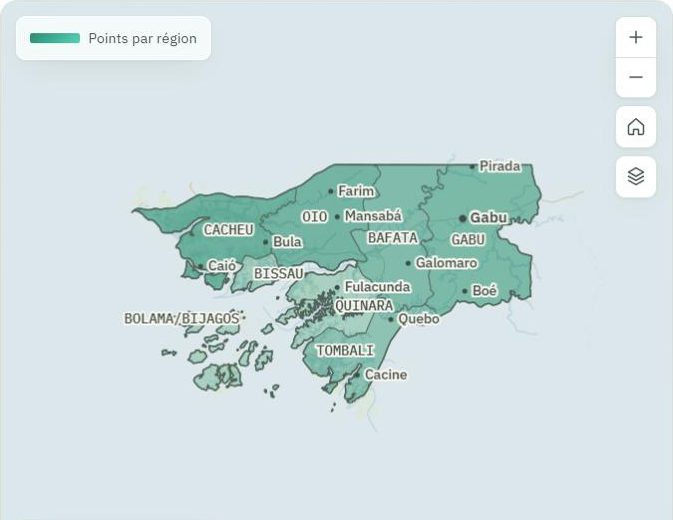
ICHESS has launched GeoSaúde GB 360, the interactive map produced by the geo-referenced mapping of curandeiros (traditional practitioners) and community health workers (CHWs) in Guinea-Bissau, carried out with the Ministry of Public Health (MINSAP/DSSCPMT) with support from UNDP and the Global Fund. The bilingual Portuguese–French platform presents results consolidated on 8 September 2026 for all 11 health regions of the country.
Key figures
- 2,182 curandeiros enumerated, of whom 2,006 geo-referenced (91.9% with a validated location), and 3,264 CHWs geolocated
- 68.8% of curandeiros live within 1 km of a CHW (median distance: 0.39 km), and 93.3% within 3 km
- 95.4% of curandeiros say they are willing to collaborate with the health system
- 982 priority curandeiros for linkage with a CHW (no current interaction and willing to collaborate), 672 of them less than 1 km away
- 35.2% of curandeiros are women
What the platform offers. A national dashboard that can be filtered by region; a map of coverage and distances between curandeiros and CHWs; a linkage plan to target priority connections; views by territory and health area; the profile of curandeiros (categories, most frequently treated health problems); a data quality module; and the method, sources and governance rules. Every indicator is calculated from the integrated records and can be exported as a PDF report.
Why it matters. For the first time, Guinea-Bissau has a national database that places traditional medicine alongside the CHW network. It helps the Ministry and its partners plan collaboration between the two systems, strengthen referral to health facilities and monitor priority areas.
Privacy. The public edition shows aggregated data only; individual records remain under restricted access, in line with the project’s governance rules.
Read also: launch of the mapping with the Ministry of Public Health (30 June 2026)
Read also: 285 field agents trained for data collection (July 2026)